
How TAPCO energy works, and what each upgrade actually does
Every figure on this page is read from the server that enforces it. Energy is what limits how fast you can tap; the nine cards in the upgrades panel are what change that limit, and what each of them costs and delivers is set out here in full.
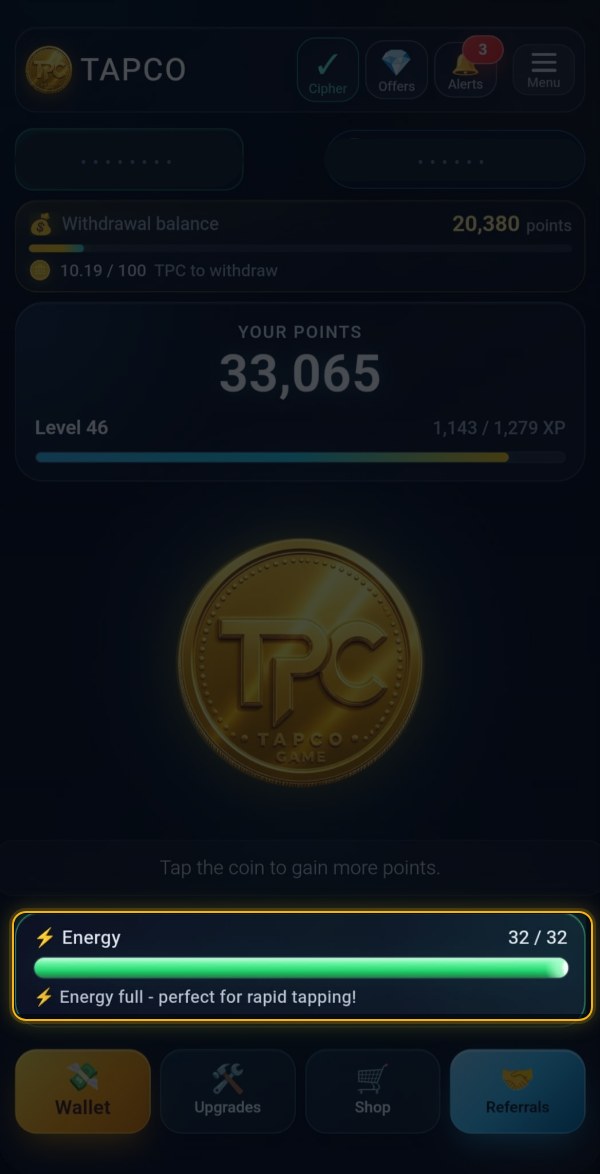
How energy works
You start with a tank of 20 energy. Every tap costs one, and the tank refills on its own at half an energy a second — so an empty tank is full again in forty seconds, and a tank that is never allowed to fill hands you thirty taps a minute for as long as you keep tapping.
Below three energy the game stops accepting taps. That floor exists so the tank cannot be held permanently at zero, where every tap would arrive as a refusal; it lets the tank build a small reserve before you start again.
Taps are sent to the server in batches of up to twenty, and two taps closer together than 55 thousandths of a second are not counted — a ceiling of about eighteen taps a second, which is faster than a hand goes and slower than a script.
Energy does regenerate while you are away, and the game credits it when you come back. That credit is worked out over at most six hours: leaving for a day and returning does not hand you a day of energy, because the tank could never have held it. With a 20 tank and half an energy a second, the tank refills long before the six hours are near — the window only ever matters to a player whose regeneration is fast and whose tank is large.
What a tap is worth is counted in points, and the rate they convert at and the limits on converting them are published in full.
The nine cards, one by one
These nine are the whole of the upgrades panel. They sit inside a larger set of systems, and how the game works as a whole introduces each of them; why energy is tuned to the pace it is, rather than to a faster one, is the subject of our note on balancing an energy system.
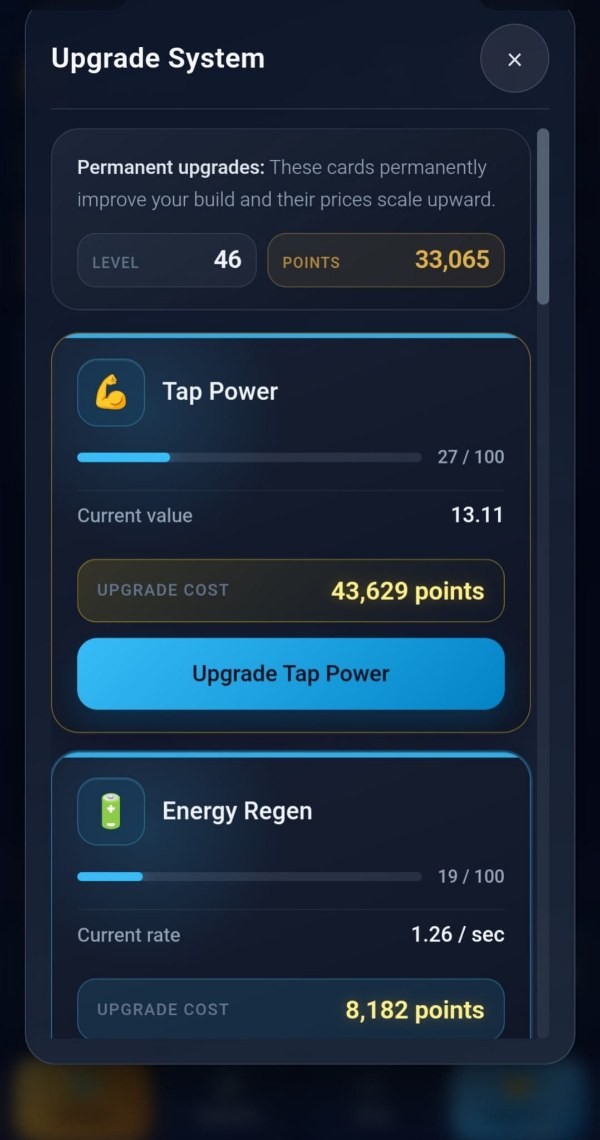
Tap Power multiplies what every tap is worth by 1.1 for each level, and it compounds: ten levels is not ten per cent more but two and a half times more. It runs to level 100 and its price rises by 18% a level from 500, which makes it the cheapest first purchase in the panel and the most expensive to finish.
Energy Regen adds 0.04 energy a second to the half you start with. Ten levels take you from thirty taps a minute to fifty-four; at level 50 the tank refills at two and a half a second. It runs to 100 and rises 12% a level from 950 — the gentlest curve of the three long upgrades.
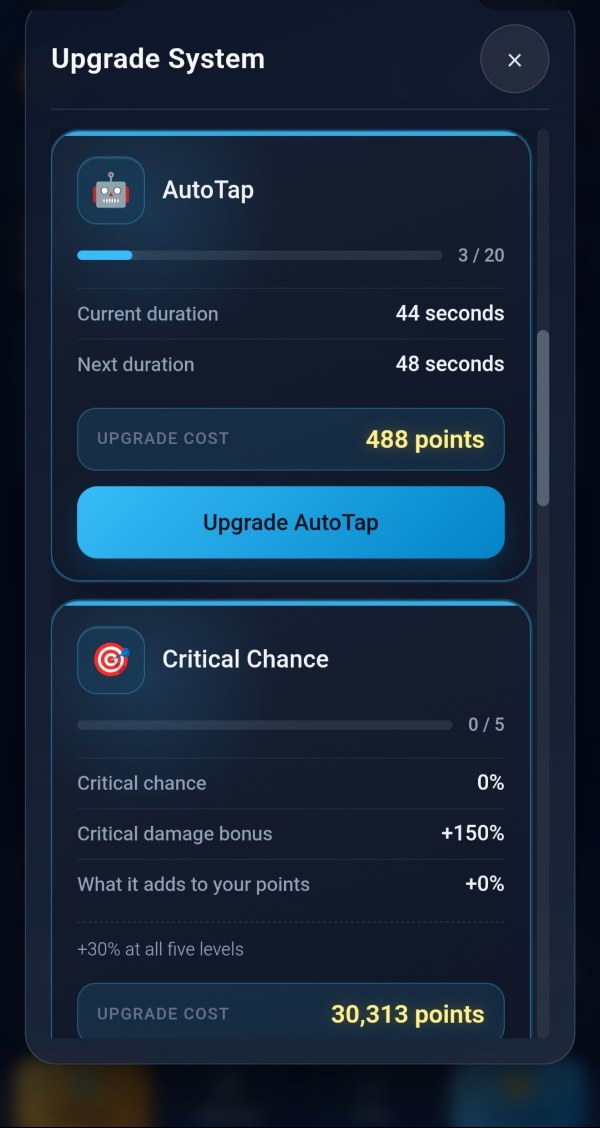
AutoTap is not a permanent tapper: it is a boost you buy in the shop, and this upgrade sets how long each one lasts. Thirty seconds at level 0, four and a half seconds longer for each level, to a ceiling of two minutes at level 20. The whole of it costs 85,727 points, which makes it the only long upgrade a player can realistically finish.
Critical Chance gives each tap a chance to pay 150% extra. Four per cent a level to twenty at level 5. Taken together that is roughly a thirty per cent rise on everything you tap, for ever.
It is the one card in the panel whose price is not the same for everybody. It costs whichever is greater: the figure in the table, or twenty-four minutes of your own income. A new player pays 2,200 for the first level; a player earning a thousand points a minute pays what a thousand points a minute buys in twenty-four minutes. Nothing lowers the price below the table, and the reason it rises is that this upgrade is worth proportionally more to a player who taps for more - a flat price would make it free for them and expensive for a beginner.
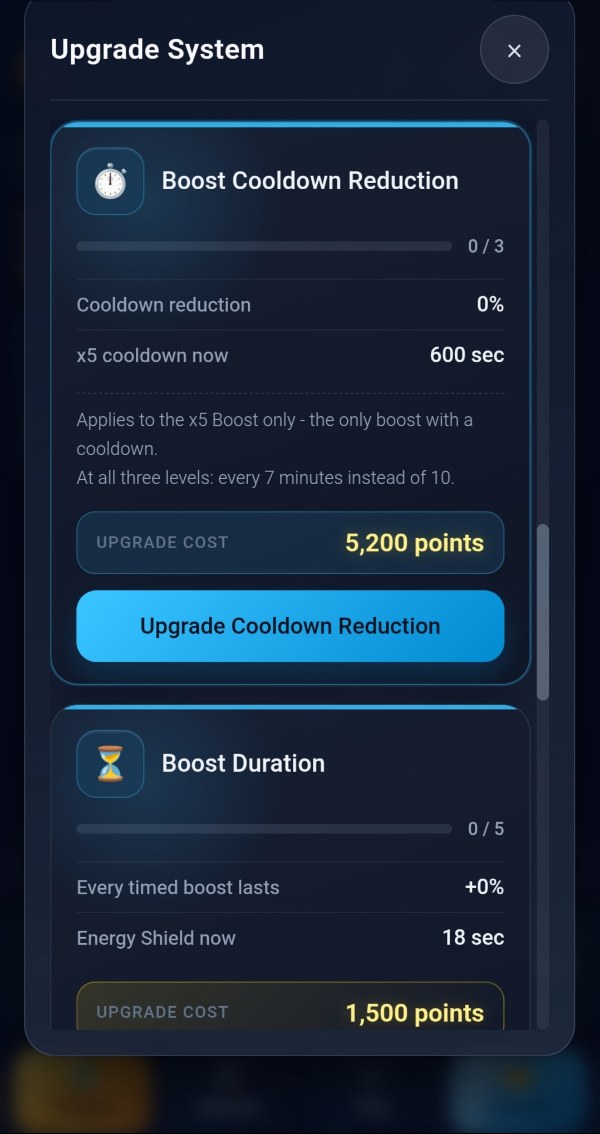
Boost Cooldown Reduction touches the x5 boost and nothing else, because it is the only boost in the game with a cooldown. Three levels take the wait from ten minutes to about eight and three quarters, then a little under eight, then seven.
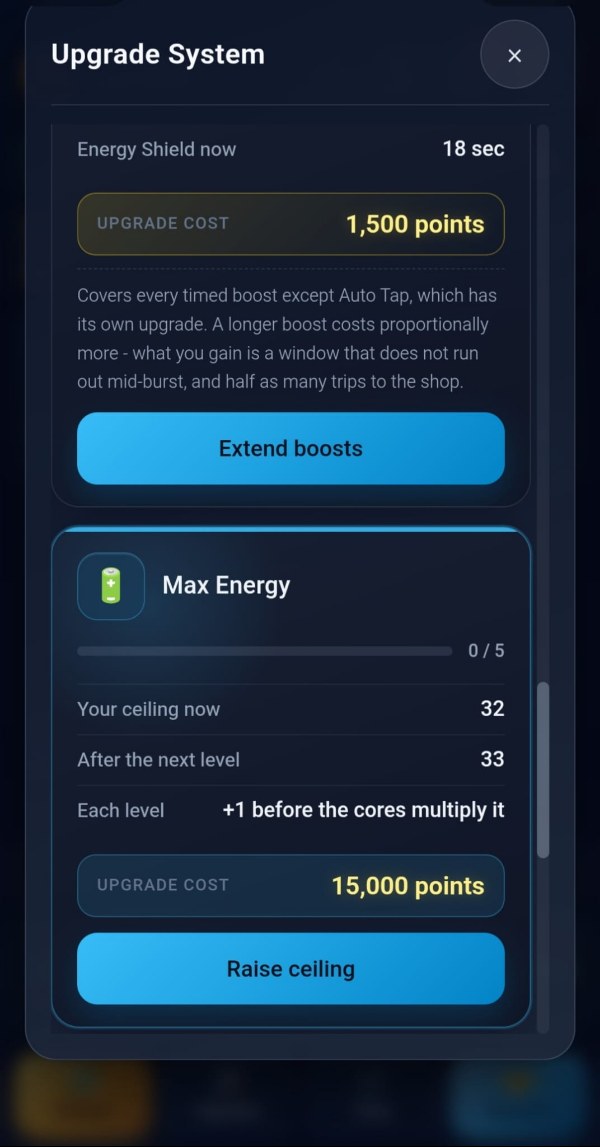
Boost Duration makes every timed boost last ten per cent longer per level, to fifty per cent at level 5. The auto-tapper is deliberately left out, since it has its own upgrade above. This does not make a boost a better deal — a boost is priced from the points it produces, so a longer one costs proportionally more. What it buys is continuity: a window that does not run out in the middle of a burst, and half as many trips to the shop.
Max Energy adds one to the tank per level, to five levels. One energy sounds small, and on its own it is; it is worth having because it is added before the Energy Core multiplies the tank, so a level bought later hands over more than the same level bought first.
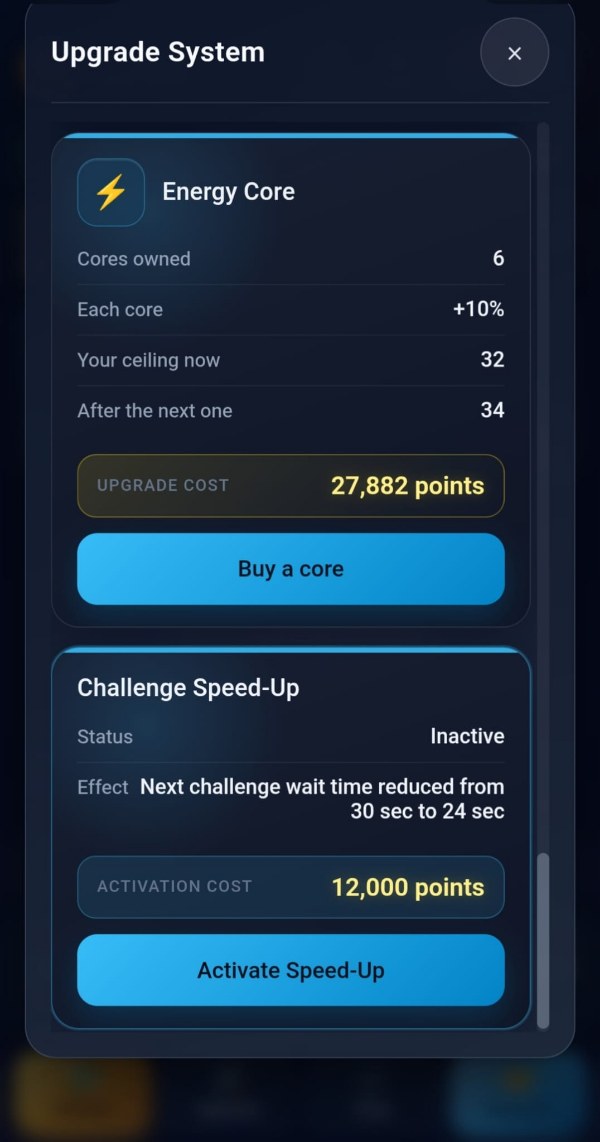
Energy Core is not a levelled upgrade at all — it is a shop item you can own several of, sitting in the upgrades panel because it raises the same ceiling. Each one you own adds ten per cent of the base tank. The first costs 3,000 points and each further one costs 45% more than the last.
Challenge Speed-Up is bought once, for 12,000 points, and it never levels again. It makes challenges appear every 24 seconds instead of every 30.
The numbers, as the server enforces them
| Value | Amount |
|---|---|
| Starting tank | 20 |
| Refills at | 0.5 / second |
| Cost of one tap | 1 |
| Tapping stops below | 3 |
| Taps sent in batches of up to | 20 |
| Fastest counted tap interval | 55 ms |
| Regeneration credited while away, at most | 6 hours |
| Card | What each level gives | Levels | First level | All levels |
|---|---|---|---|---|
| Tap Power | ×1.1 on every tap, compounding | 100 | 500 | 42.8 billion |
| Energy Regen | +0.04 energy a second | 100 | 950 | 661 million |
| AutoTap | +4.5 seconds of auto-tapping | 20 | 250 | 85,727 |
| Critical Chance | +4% chance, paying +150% | 5 | 2,200 or more | 34,000 |
| Max Energy | +1 on the tank | 5 | 15,000 | 181,000 |
| Boost Duration | +10% on every timed boost | 5 | 1,500 | 25,000 |
| Boost Cooldown | x5 boost: 10 minutes down to 7 | 3 | 5,200 | 31,800 |
| Challenge Speed-Up | Challenges every 24 s instead of 30 | 1 | 12,000 | 12,000 |
| Energy Core | +10% of the base tank, each one owned | shop item | 3,000 | ×1.45 each time |