
The Daily Cipher: five characters, and only two of them are yours
A padlock sits in the top bar of the game. It opens at eighteen hundred UTC — the game prints the hour in your own time, so most players see it as an evening — and it closes at midnight. Behind it are five boxes, and two of them are already filled in.
The other three are not a riddle with a clever answer. They are simply characters you were not given, and somebody else was. Nobody can solve it alone on purpose.
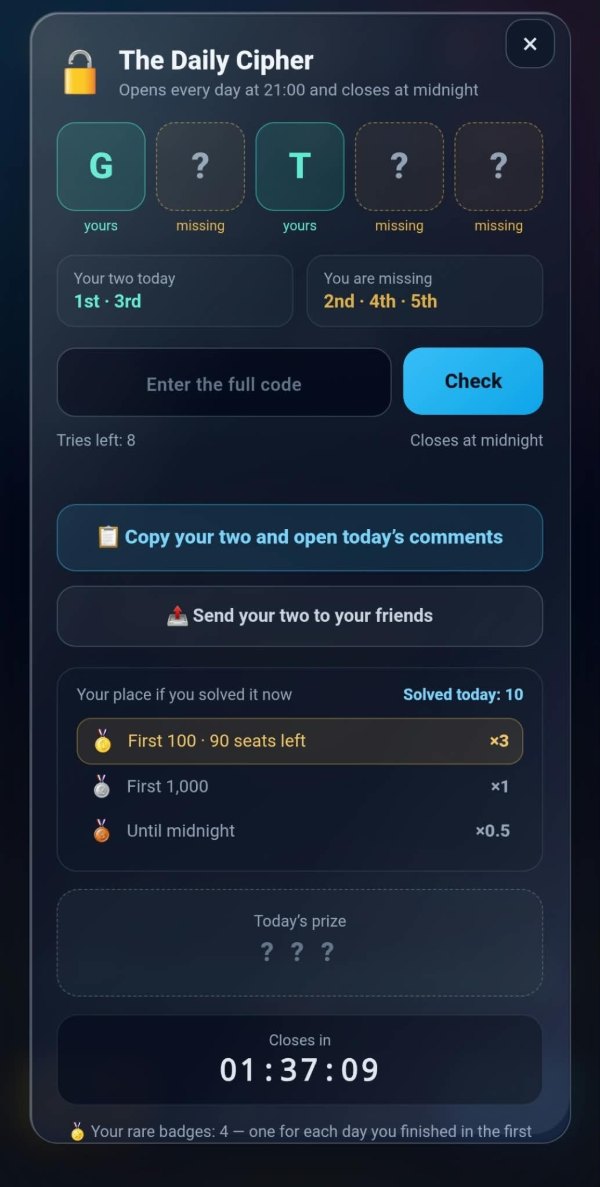
Two of five, and thirty thousand ways to be wrong
The code is five characters long, drawn from an alphabet of thirty-one: the twenty-six letters minus I, L and O, and the digits two to nine. Those five are left out because a capital I, a lowercase l and a one look alike, and so do a capital O and a zero — and a puzzle solved by typing what somebody told you should not be lost to a font.
You are shown two of the five. The three you are not shown leave thirty-one to the power of three — 29,791 — possible codes, and the panel gives you eight attempts. Guessing is not a strategy; it is a rounding error.
What is left is to ask. Each player holds a different pair, so three or four people between them usually hold the whole code. The panel has a button that copies your two and opens the day’s post in the announcement channel for your language, which is where the trading happens.
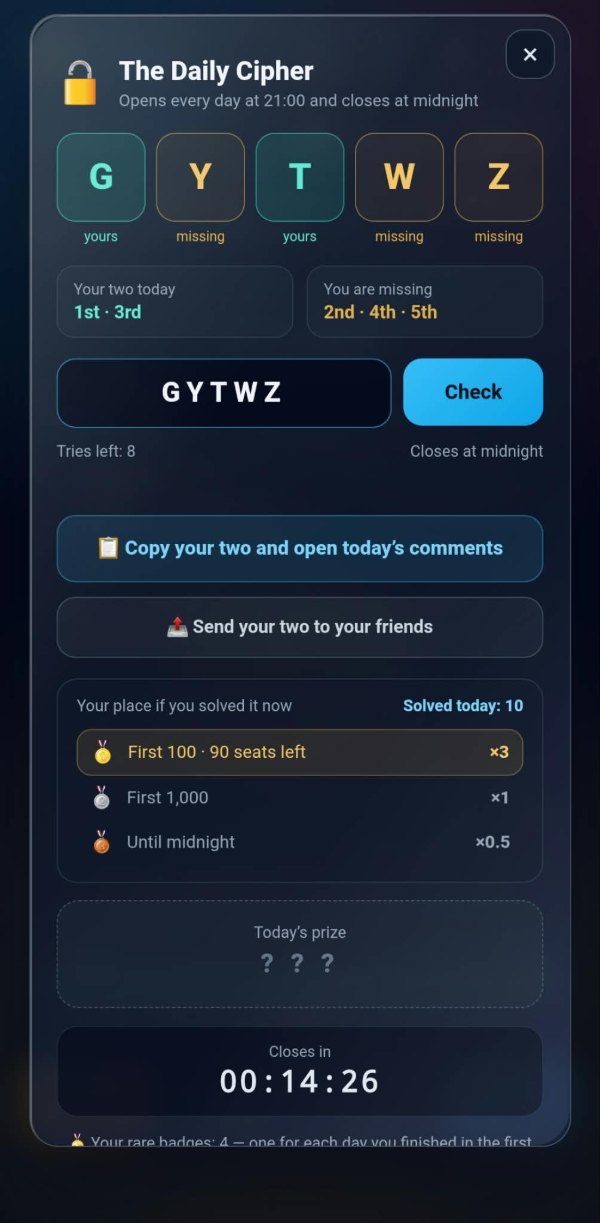
What it pays, and why speed is worth something
There is one prize a day and it is drawn from three possibilities. Forty-five days in a hundred it is half an hour of doubled points; thirty-five days it is between 800 and 2,500 points; twenty days it is between 5,000 and 8,000. What the day is worth is the same for everyone who solves it.
Where you finish changes the multiplier, not the prize. The first hundred solvers are paid three times it, the next nine hundred once, and everybody after that half. So an evening spent trading characters is worth more than an evening spent waiting for somebody else to post the answer, and the difference is real without the late solver getting nothing.
The first hundred also receive a rare badge, which is a mark of having done it and never a substitute for the prize. Badges are counted on the achievements panel, beside the fifty classic and fifty mid-game ones.
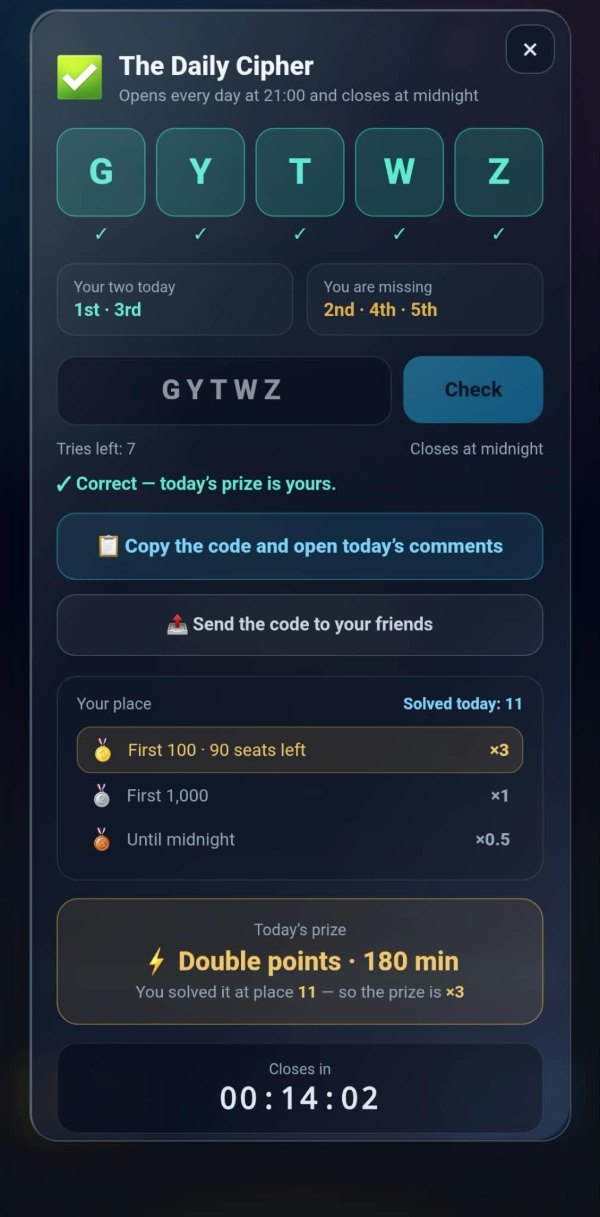
Eight attempts, and what happens at midnight
Eight wrong answers close the puzzle for you until the next evening. That number is not there to punish a typing mistake — it is there so that nobody can simply work through the thirty thousand codes, which at eight tries a day would take ten years.
At midnight the day closes for everyone, solved or not, and a new code is set for the next evening. Nothing carries over: an unsolved cipher pays nothing and costs nothing.
The padlock only shows in the top bar while the puzzle is open. Everything else in the game keeps running through it — the events and the passive income do not pause while you are typing.